

You love tracking your health but are tired of constantly checking a smartwatch screen? Screenless fitness bands are becoming a great alternative. Instead of distracting you with notifications, these wearables quietly collect health data throughout the day and present everything inside their companion apps.
Two of the biggest names in this category are Garmin Cirqa and Fitbit Air. Both launched in 2026 with a similar goal: provide continuous health, sleep, and recovery tracking without adding another screen to your daily life.
So, which one is worth your money?
In this Garmin Cirqa vs Fitbit Air comparison, I’ll break down the differences in design, battery life, health tracking, fitness features, pricing, and overall value to help you choose the right one.
Also read: Garmin Cirqa Vs Fitbit Air: Which Screenless Fitness Band Should You Buy?
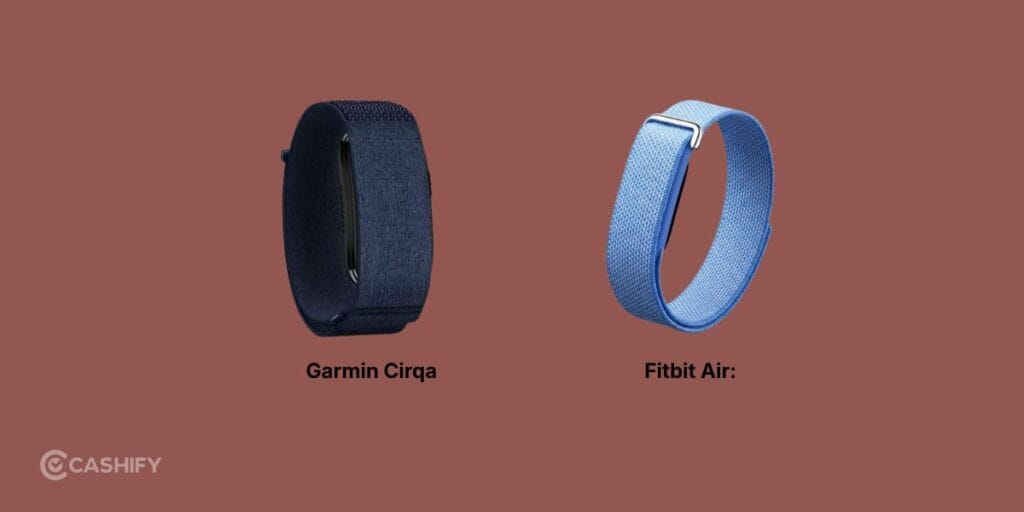
Garmin Cirqa Vs Fitbit Air: Quick Comparison!
| Feature | Garmin Cirqa | Fitbit Air |
|---|---|---|
| Expected Price (India) | Around Rs. 17,000–Rs. 18,000 | Around Rs. 8,500–Rs. 9,500 |
| Display | Screenless fitness band | Screenless fitness band |
| Battery Life | Up to 10 days | Up to 7 days |
| Weight | Around 20g | Around 12g |
| GPS | Uses your smartphone’s GPS | Uses your smartphone’s GPS |
| Water Resistance | 5 ATM (50m) | 5 ATM (50m) |
| Workout Tracking | 80+ workout modes with advanced training metrics | Automatic activity tracking with fewer workout profiles |
| Best For | Runners, cyclists, gym-goers, and fitness enthusiasts | Casual users focused on health, sleep, and daily wellness |
| AI Features | Optional Garmin Connect+ coaching | Gemini AI Health Coach (Premium) |
| Subscription Required? | No, core features are free | No, core features are free (Premium AI features available separately) |
Also Read: Best Smartwatches Under 5000 Rupees In India
Garmin Cirqa vs Fitbit Air: Design and Comfort
One thing both devices get right is simplicity.
Instead of a display, both wearables quietly collect data in the background. That means no buzzing notifications, no endless watch faces, and fewer reasons to check your wrist every few minutes.
Garmin Cirqa
Garmin Cirqa uses a fiber-reinforced polymer body with lightweight fabric straps available in multiple colours. You can wear it on your wrist or even your upper arm, which is useful during workouts.
It weighs around 20 grams, making it light enough for all-day wear without feeling bulky.
Fitbit Air
Fitbit Air takes minimalism even further.
The sensor itself weighs just over 5 grams, while the complete band weighs roughly 12 grams. Many users describe it as something you almost forget you’re wearing.
If sleep tracking is your priority, this extra comfort can make a noticeable difference over time.
Winner: Fitbit Air
Its lighter design simply disappears on your wrist, making it ideal for 24/7 wear.
Garmin Cirqa vs Fitbit Air: Battery Life
Battery life matters more on screenless wearables because they’re designed to stay on your wrist continuously.
Garmin Cirqa
- Up to 10 days of battery life
- Less frequent charging
- Great for travel or long training weeks
Fitbit Air
- Up to 7 days
- Extremely fast charging
- Just 5 minutes of charging provides about one day of use
- Full charge takes around 90 minutes
Personally, I’d rather charge less often than charge quickly. If you’re someone who forgets to plug in devices, Garmin definitely has the advantage here.
Winner: Garmin Cirqa
Also read: 5 Best Smartwatches for Women In India
Garmin Cirqa vs Fitbit Air: Health Tracking Features
Both devices include the essential health sensors most people expect in 2026.
Shared Features
- 24/7 heart rate monitoring
- HRV tracking
- Blood oxygen (SpO2)
- Skin temperature
- Sleep tracking
- Recovery insights
- Women’s health tracking
- Smart wake vibration alarms
- Water resistance up to 50m
For everyday health monitoring, either device will cover the basics very well.
Garmin Cirqa vs Fitbit Air: Fitness Tracking
This is where the biggest difference appears.
Garmin Cirqa
Garmin clearly built Cirqa for people who train regularly.
It includes:
- 80+ workout profiles
- VO2 Max
- Body Battery
- Training Readiness
- Training Status
- Recovery Time
- Sleep Coach
- Circadian rhythm insights
- Better workout auto-detection
It also integrates smoothly with Garmin watches, making it an excellent companion if you already own a Forerunner or Fenix.
Fitbit Air
Fitbit Air focuses more on overall wellness than athletic performance.
It offers:
- Activity tracking
- Cardio Load
- Readiness score
- AFib detection
- Excellent sleep insights
- Automatic activity recognition
- Recovery tracking
It doesn’t provide the same level of sports analytics as Garmin, but that’s intentional. Fitbit Air is designed for users who simply want to stay healthier without diving into complex performance metrics.
Winner: Garmin Cirqa
Serious runners, cyclists, gym-goers, and endurance athletes will appreciate the extra depth.
Also read: Best Smartwatches With Calling Feature in India.
Garmin Cirqa vs Fitbit Air: Companion Apps
The wearable itself doesn’t have a screen, so your experience depends heavily on the app.
Garmin Connect
Garmin Connect remains one of the most detailed fitness platforms available.
You’ll get:
- Advanced training analysis
- Historical performance trends
- Recovery recommendations
- Detailed workout metrics
- Optional Connect+ subscription for advanced coaching
The core experience remains free, which is a huge plus.
Google Health App
Fitbit Air now uses Google’s Health app.
The biggest highlight is the Gemini AI Health Coach, which provides:
- Personalized summaries
- Wellness recommendations
- Mindfulness guidance
- Daily health insights
- AI-powered coaching (Premium)
The interface is cleaner and more beginner-friendly than Garmin Connect.
If you already use Android or Pixel devices, the overall experience feels well integrated.
Winner: Tie
Choose Garmin for detailed analytics.
Choose Fitbit for a simpler AI-driven experience.
Garmin Cirqa vs Fitbit Air: Price and Value
For Indian buyers, price could be one of the biggest deciding factors.
Garmin Cirqa
- Expected price: Around Rs. 17,000– Rs. 18,000
- No mandatory subscription for core features
- Includes advanced training and recovery metrics at no extra cost
- Better value for serious fitness enthusiasts and athletes
Fitbit Air
- Expected price: Around Rs. 8,500– Rs. 9,500
- Includes 3 months of Google Health Premium
- Core health and fitness tracking remains free after the trial
- Premium AI coaching is available as an optional subscription
For someone in India buying their first screenless fitness band, Fitbit Air is the more budget-friendly option. At roughly half the expected price of Garmin Cirqa, it offers excellent health tracking, sleep monitoring, and AI-powered wellness insights without a huge upfront investment.
Garmin Cirqa costs considerably more, but the extra money goes toward features that regular runners, cyclists, gym-goers, and endurance athletes will actually appreciate. If you want detailed training analysis, longer battery life, and advanced recovery metrics without relying on a paid subscription, the higher price can be justified.
Winner: Fitbit Air
If value for money is your priority, Fitbit Air is the better pick. However, fitness enthusiasts looking for deeper performance insights may find Garmin Cirqa worth the extra investment.
Also read: Amazon Upcoming Sale: Sale Dates, Offers, All Details!
Garmin Cirqa vs Fitbit Air: Pros and Cons
| Garmin Cirqa | Fitbit Air |
|---|---|
| Longer battery life | Lower price |
| Excellent athlete-focused metrics | Extremely lightweight |
| 80+ workout modes | Excellent sleep tracking |
| Body Battery and Training Readiness | Gemini AI coaching |
| Strong Garmin ecosystem | Beginner-friendly app |
| More expensive | Fewer advanced sports metrics |
| Slightly heavier | Shorter battery life |
Final Thoughts
When comparing Garmin Cirqa vs Fitbit Air, there’s no universal winner because both target different users.
If your routine revolves around running, cycling, strength training, or endurance sports, Garmin Cirqa is the stronger investment. Its advanced training metrics, longer battery life, and subscription-free core experience justify the higher price. It also feels like the obvious choice if you’re already part of the Garmin ecosystem.
For most people, though, Fitbit Air will likely be the better buy. It’s lighter, significantly more affordable, incredibly comfortable to wear around the clock, and delivers excellent health and sleep tracking without overwhelming you with data. The Gemini-powered coaching also makes daily insights easier to understand and act on.
My recommendation is simple: choose Garmin Cirqa for performance-focused fitness, and Fitbit Air for effortless everyday wellness. Both are excellent examples of how screenless wearables have matured in 2026, but the best choice ultimately depends on how much detail you actually want from your fitness tracker.
If you’ve just bought a new phone and don’t know what to do with your old phone, then here’s your answer. Sell your old mobile to Cashify and get the best price for it. If you are planning to buy a new phone, check out Cashify’s refurbished mobile phones. You can get your favourite phone at almost half price with a six-month warranty, 15-day refund and free delivery.